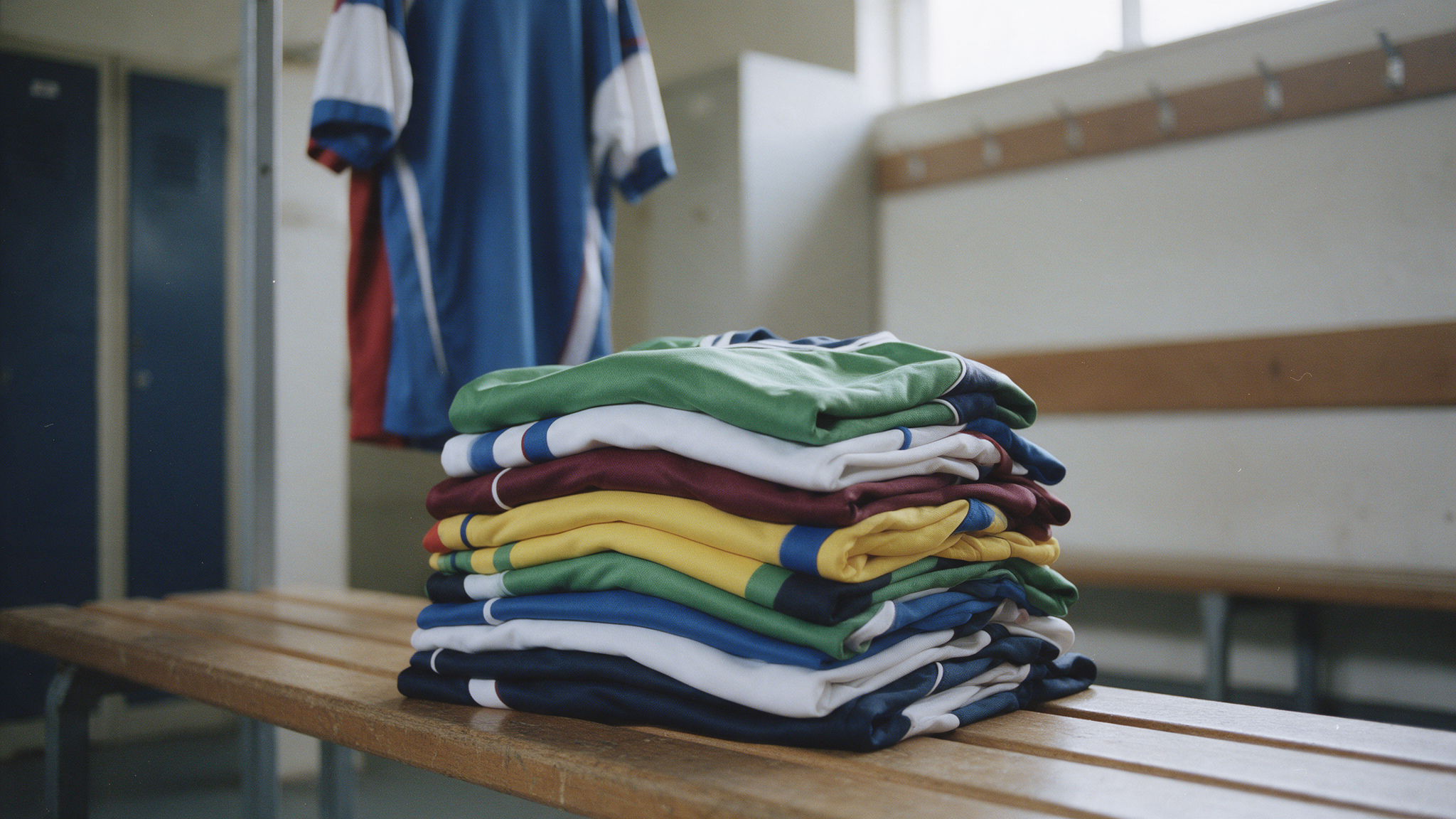
Every new season, the same scene plays out in the changing room. Replica shirts from professional clubs keep climbing — several cross the €100 mark for 2026-2027 — while the amateur club treasurer is asking a far more down-to-earth question: how much will our jersey set actually cost? The honest answer is "it depends" — but it depends on specific, listable factors you can put a number on. Here's how to work it out before you sign off the season's budget.
Supporter shirt vs team jersey: two completely different budgets
First, clear up the confusion. The shirt you buy in a shop to watch a match and the jersey your squad wears on the pitch follow entirely different logics. The first is a licensed product, sold individually with a retail margin; its price reflects the club's fame as much as the fabric. The second is a piece of functional kit, ordered in a batch for a defined group, with no licence to pay for.
In other words, comparing a pro replica to a club jersey set makes no sense. What matters to you is the per-unit cost of a personalised batch in your own colours — a completely different calculation.
What actually makes up the price of a jersey set
The price of a custom jersey is built from several blocks. Knowing them means knowing where you can act on the budget:
- The base garment: the cut (fitted or relaxed), the collar type, the sleeve length. A long-sleeve or a technical fit sits above a standard model.
- Design personalisation: with full dye sublimation, the pattern, stripes and palette are printed into the fibre. The number of colours adds nothing to the price — a full gradient costs the same as a solid block.
- Logos and sponsors: on a sublimated jersey they're built into the design at no extra cost, however many there are. It's a line item that weighs heavily elsewhere and is neutral here.
- Names and numbers: a per-piece option, added if you want individual player lettering.
- Quantity: the single most decisive factor. The larger the run, the lower the unit cost.
- The full kit: pairing the top and bottom of the same sport unlocks a discount on the set.
For the exact figures for your configuration, the pricing page carries the up-to-date grid; we deliberately avoid quoting amounts here that would quickly go stale.
The quantity effect: why the price drops as the squad grows
This is lever number one on your budget. Sublimation manufacturing works in tiers: the unit price of a jersey ordered in fives is not the price of a 20- or 40-piece run. The good news for small clubs is that there is no minimum order: production starts from a single piece, so you can kit out a mid-season newcomer without re-running a whole batch.
The logic for a club: pool your needs. Rather than three scattered orders (the first team in September, the U15s in October, the staff in November), one grouped order at the start of the season mechanically brings down the cost per piece. Our guidance on framing the whole thing is set out in the club budget guide.
Sublimation: a full design with no colour surcharge
On value for money, sublimation changes the game compared with heat-transfer lettering. With transfers, every element added (an extra colour, a logo, a stripe) is charged and stacks up on the garment; the design sits on top of the fabric and can crack or peel over time. With sublimation, the colour penetrates the fibre: it doesn't flake, doesn't fade in the wash, and a busy design costs no more than a plain one.
In practice, that means you can aim for a genuine club look — side panels, contrasting shoulders, integrated sponsors — without blowing the budget. The spend concentrates on the garment and the quantity, not on the number of graphic elements.
Estimate your budget in 4 steps
To get a reliable figure rather than a vague range, work through it in order:
- 1. Count the pieces. Players, substitutes, staff, an away set if any: the total number sets the price tier.
- 2. Fix the product. Cut, collar, sleeves, top + bottom kit or jersey only. A football jersey for clubs and teams comes in several models depending on use.
- 3. Frame the personalisation. Design, sponsors, and decide whether to add per-piece names and numbers.
- 4. Request a quote. With these elements you'll get a precise costing, proof included before any production — nothing goes to manufacturing without your sign-off.
In the back-to-school rush, the production calendar is busy: allow several weeks between artwork approval and delivery. Planning ahead remains the best way to keep a grip on both the budget and the lead time.
Key takeaways
- The price of a jersey set depends mainly on quantity, the chosen garment and options (names/numbers) — not on the number of colours.
- With sublimation, logos and sponsors are built in at no extra cost: a rich design costs no more than a plain jersey.
- No minimum: production from a single piece, with a price that drops in tiers as the run grows.
- A top + bottom kit in the same sport unlocks a discount on the set.
- European manufacturing (Bulgaria, EU), proof approved before production, current prices on the pricing page.
Frequently asked questions
How much does a set of team jerseys cost for an amateur club?
There's no single price: the cost per jersey depends on the quantity ordered, the model (cut, collar, sleeves), whether you add names and numbers, and whether you choose a top + bottom kit. The best way to get an accurate figure is to request a quote with these details; the current grid is on the pricing page.
Do more colours or sponsors push the price up?
No. With full sublimation the design is printed into the fibre: a complex pattern, gradients and several sponsors carry no surcharge over a plain jersey. That's the big difference from heat-transfer lettering, where every added element is charged.
Is there a minimum order?
No, production starts from a single piece. That's handy for kitting out a player who joins mid-season without re-running a whole batch. That said, the more you group the order, the lower the unit cost.